
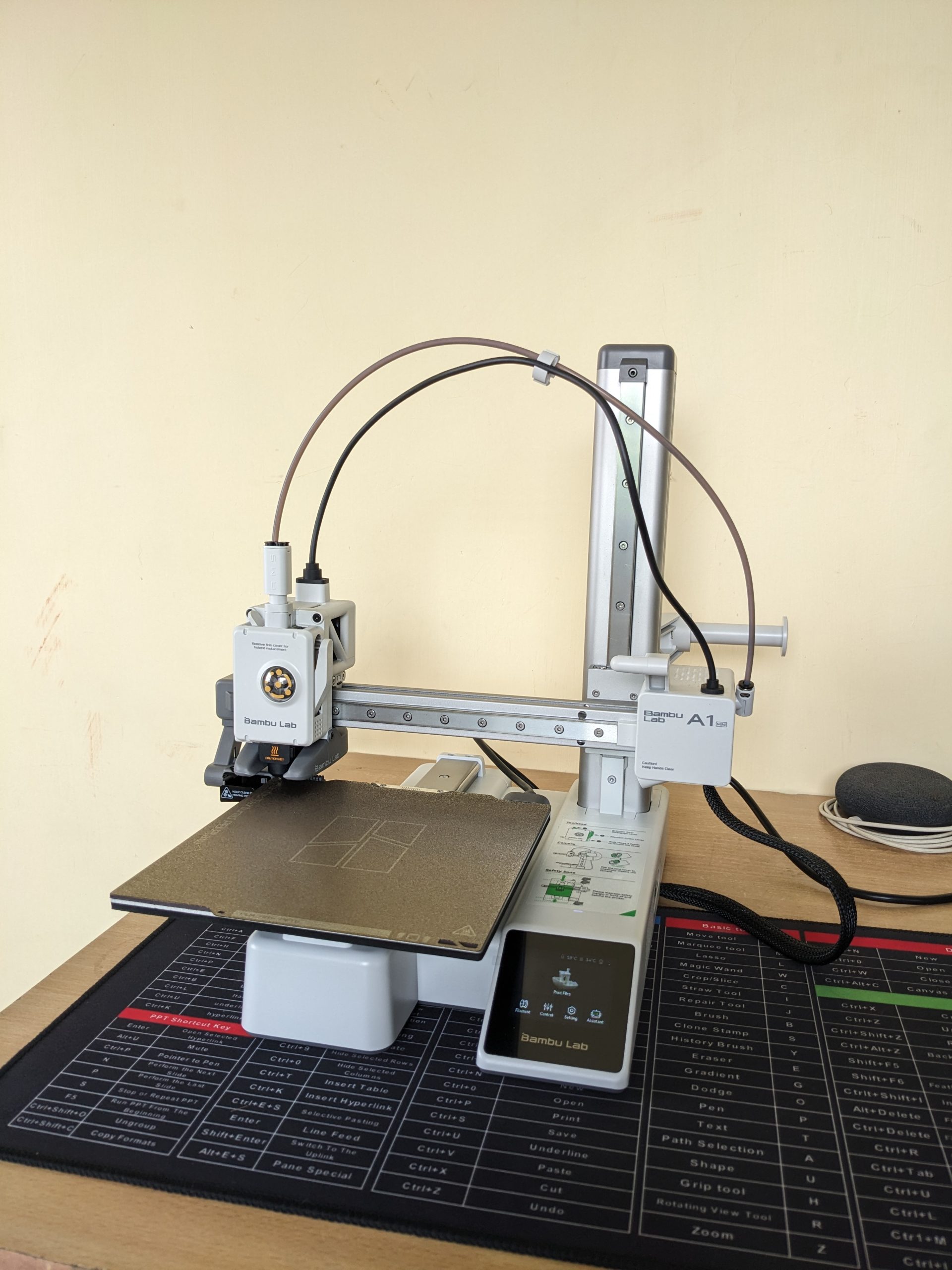
My First 3D Printer: Why I Chose the Bambu Lab A1 Mini (and How I Got It from Robu.in)

Bambu Lab A1 Mini Printer

Thinking about getting into 3D printing? If you’re anything like me, you’ve probably spent hours watching videos, reading reviews, and trying to figure out which printer is the best for a beginner. After a lot of research, I decided to pull the trigger on the Bambu Lab A1 Mini, and I’m so glad I did. I want to share my entire experience, from the moment I clicked “buy” on Robu.in to the moment the printer arrived at my doorstep.

Why the Bambu Lab A1 Mini is a Top Recommendation for Beginners

When I started my search, I knew I wanted a printer that was easy to use, reliable, and didn’t require constant tinkering. The Bambu Lab A1 Mini checked all those boxes and more. Here’s a quick rundown of what makes this printer stand out from the competition:

  • Effortless Setup and Calibration: This was a huge selling point for me. The A1 Mini has a fully automatic calibration system. It handles the bed leveling, Z-offset, vibration resonance, and pressure advance on its own. It’s a true “plug-and-play” experience, which is a massive relief for a first-timer.
  • Insane Speed: You’ll be amazed at how fast this printer is. With a maximum toolhead speed of 500textmm/s and an acceleration of 10,000textmm/s2, you can get your prints done in a fraction of the time compared to other entry-level printers. Less waiting means more creating!
  • Quiet Operation: One of the most common complaints about 3D printers is the noise. The A1 Mini’s active motor noise canceling feature makes it surprisingly quiet. This is great if you plan to have it in a shared living space or a home office.
  • Smart and Reliable: The printer is packed with sensors that prevent common printing failures. The filament run-out and tangle sensors, along with the power loss recovery feature, mean your prints are protected from unexpected issues.

In my opinion, the Bambu Lab A1 Mini is the perfect machine for anyone who wants to jump into 3D printing without the steep learning curve. It’s a solid investment that delivers on its promises.


My Experience Buying from Robu.in

As a maker in India, finding a reliable supplier for high-tech gadgets can be a challenge. I stumbled upon Robu.in and was immediately impressed by their extensive catalogue of electronics, robotics, and 3D printing supplies.

The website was easy to navigate, and finding the Bambu Lab A1 Mini was a breeze. The checkout process was straightforward, and they provided multiple secure payment options, which gave me confidence in my purchase.

Because my location is on the outskirts of the city, I expected the delivery to take a bit longer. However, the wait was completely worth it. The best part? The courier service. My package was handled by BlueDart, and I was really impressed with their service. Despite some online reviews mentioning mixed experiences, my personal delivery with them was great. The package was in perfect condition, and the delivery person was very professional and ensured it was handed over to me safely. This kind of reliable courier service is crucial when you’re buying a delicate and expensive piece of equipment.


What’s Next? Stay Tuned!

The printer is here, and I’m itching to get it unboxed and set up! I’m planning to document my entire experience, from the unboxing to my very first prints, on my new YouTube channel.

I’ll be sharing an in-depth unboxing video soon, where you’ll get a close-up look at the Bambu Lab A1 Mini and all its components. If you’re considering this printer, or just want to follow along on my 3D printing journey, be sure to subscribe to my new YouTube channel and hit the notification bell.

My experience with Robu.in and BlueDart has been excellent, and I can confidently recommend them. Now, it’s time to fire up this printer and see what it can do!

Beyond the Hype: The Hard Truth About Generative AI’s 95% Failure Rate

AI Faulure

Is the hype around generative AI starting to deflate? A groundbreaking new study from MIT is sending shockwaves through the tech world, revealing that a staggering 95% of generative AI projects are failing to deliver real business value. This eye-opening statistic is fueling concerns of a potential tech bubble, leaving many to wonder if the AI revolution is more fizz than bang.

We’ve all seen the headlines promising transformative power, from AI chatbots revolutionizing customer service to AI tools supercharging content creation. But the reality, according to MIT’s “The GenAI Divide: State of AI in Business 2025” report, is far less glamorous. While individuals are finding handy uses for these tools, enterprises are largely struggling to translate pilot projects into tangible results.

Why the Generative AI Gold Rush is Turning into a Bust:

So, what’s behind this massive failure rate? It boils down to several critical factors:

  • The “AI Adaptation Gap”: Simply deploying a powerful AI model isn’t enough. Companies are realizing that generic AI needs significant customization and integration into their unique workflows. Without this crucial step, the AI remains a shiny toy that doesn’t actually solve business problems. Think of it like buying a Formula 1 car and expecting it to navigate Mumbai’s traffic without any modifications!
  • Chasing Hype, Not Value: Many organizations jumped on the generative AI bandwagon due to FOMO (fear of missing out), launching projects without clearly defined objectives or a solid understanding of how AI would drive real business value. The result? Technically impressive projects that don’t impact the bottom line.
  • Dirty Data, Broken Infrastructure: AI thrives on high-quality data. Unfortunately, many companies are grappling with data silos, inconsistencies, and a lack of “AI-ready” data. As the saying goes, “garbage in, garbage out.” Poor data leads to unreliable AI outputs and stalled projects.
  • The Overpromise Problem: The capabilities of generative AI have been heavily hyped, leading to unrealistic expectations. As this insightful video from Matt Berman on YouTube (Video linked below) points out, AI still struggles with many complex tasks, and the initial promises often fall short in real-world application.


The Human Cost of AI Overreach: When Automation Backfires

One of the biggest pitfalls is the rush to replace human workers with AI without a clear understanding of the nuances involved. While AI can automate repetitive tasks, many roles require uniquely human skills like emotional intelligence, complex problem-solving, and creative thinking.

Consider companies that prematurely downsized their customer service teams in favor of AI chatbots, only to face customer frustration and the need to rehire human agents. This highlights the danger of underestimating the value of human connection and adaptability in the workplace. Relying solely on AI in such scenarios can lead to:

  • Diminished Customer Experience: AI, for now, lacks the empathy and nuanced understanding to handle complex or emotionally charged customer interactions effectively.
  • Loss of Innovation: True creativity and out-of-the-box thinking often come from human intuition and collaboration, which AI cannot replicate.
  • Employee Disengagement: When employees feel like they are being replaced by machines, morale and productivity can plummet.

Where AI Still Doesn’t Belong (Yet!) 🚫

While AI’s capabilities are rapidly evolving, certain fields remain firmly in the realm of human expertise. As of now, AI is not well-suited for roles that demand:

  • High-Stakes Judgment and Creativity: Fields like artistic creation, strategic decision-making with incomplete information, and critical ethical judgments require a level of human intuition and understanding that AI currently lacks.
  • Deep Empathy and Interpersonal Connection: Professions such as therapy, counseling, nursing (especially bedside care), and teaching rely heavily on human-to-human connection and emotional intelligence.
  • Complex Physical Dexterity and Adaptability in Unstructured Environments: Think of skilled trades like plumbing, electrical work, and construction. These jobs require navigating unpredictable situations and fine motor skills that current robotic AI struggles with.

Navigating the Generative AI Landscape: A More Realistic Approach

The MIT study serves as a crucial wake-up call. Instead of blindly chasing the latest AI trends, businesses need to adopt a more strategic and realistic approach. This involves:

  • Focusing on Clear Business Problems: Identify specific challenges where AI can provide tangible solutions and measurable ROI.
  • Investing in Data Quality and Infrastructure: Ensure your data is clean, accessible, and properly formatted for AI training.
  • Prioritizing Integration and Customization: Adapt generic AI models to your specific needs and seamlessly integrate them into existing workflows.
  • Augmenting Human Capabilities, Not Replacing Them: Focus on how AI can empower employees and enhance their productivity, rather than simply trying to automate jobs out of existence.

The generative AI revolution is far from over, but the current hype cycle needs a healthy dose of realism. By understanding the limitations and focusing on strategic implementation, businesses can harness the true potential of AI without falling victim to the bursting bubble.

Feel free to subscribe and share the article. It feels good to see new subscribers and readers on the blog.